RF Detector vs Lens Finder vs Magnetic GPS Detector: A B2B Buyer Checklist
For B2B buyers, an anti-spy detector should not be evaluated as one vague "hidden-device finder." RF signal detection, close-range lens-reflection checks and magnetic-source screening answer different questions. A useful procurement brief starts by defining the inspection environment, the result the customer needs and the limits of each method.
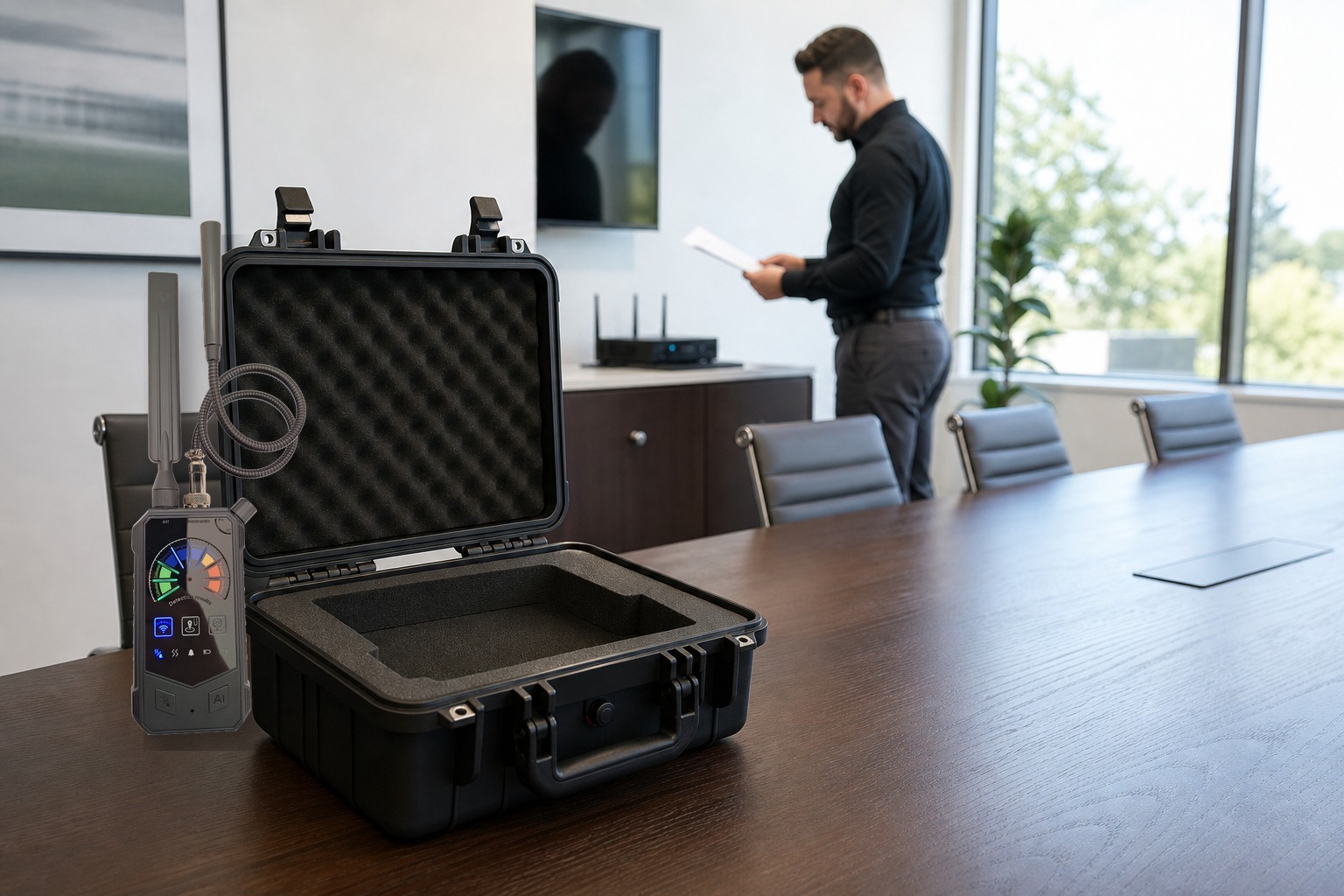
This checklist uses the EL-DE012 portable 3-in-1 detector as an example for authorized hotel, office, meeting-room and fleet-security inspections. It is designed to support a structured check; it does not certify that a room, vehicle or property is free of every hidden device. Always confirm local law, obtain permission from the property owner or responsible organization, and use trained personnel where appropriate.
Start with the inspection question, not the product label
| Function buyers ask for | What it checks | Best B2B use case | Important limit to test |
|---|---|---|---|
| RF detector | Active wireless-signal environment | Meeting rooms, offices and other places where an authorized team needs to investigate unexpected transmissions | It does not identify a signal source with certainty; nearby infrastructure can create interference. |
| "Lens finder" or IR camera check | Either close-range lens reflection, or-on EL-DE012-940 nm infrared emissions associated with night-vision cameras | Hotel rooms and controlled indoor privacy checks | Traditional lens reflection needs close access to the lens. IR checking does not promise detection of every camera or lens. |
| Magnetic GPS detector | A nearby magnetic source | Authorized fleet, vehicle and asset-security checks | A magnetic alert is not proof that the object is a GPS tracker. |
1. RF detection: use it to investigate an active signal environment
RF mode is most relevant when a buyer needs to assess whether active wireless transmissions are present in an authorized inspection area. For a conference-room program, the purchasing specification should include adjustable sensitivity, a clear alert method and a repeatable test plan. The EL-DE012 manual lists RF coverage from 10 MHz to 8600 MHz and recommends sensitivity adjustment to narrow down a source.
However, B2B buyers should test the detector in realistic conditions rather than rely on a range claim alone. Cellular infrastructure, WiFi base stations, rail systems, high-voltage lines and other strong RF sources may affect the result. The useful question is not "Can it name every device?" but "Can trained staff repeat the same screening process and record exceptions for follow-up?"
2. Why the DE012 940 nm check is different from a pure lens finder
Buyers often use "lens finder" as a broad search term, but there are two distinct approaches. A conventional lens-reflection check depends on seeing reflected light from a camera lens. It normally requires the operator to get very close to the lens and can be difficult when the lens is small, obstructed or poorly positioned.
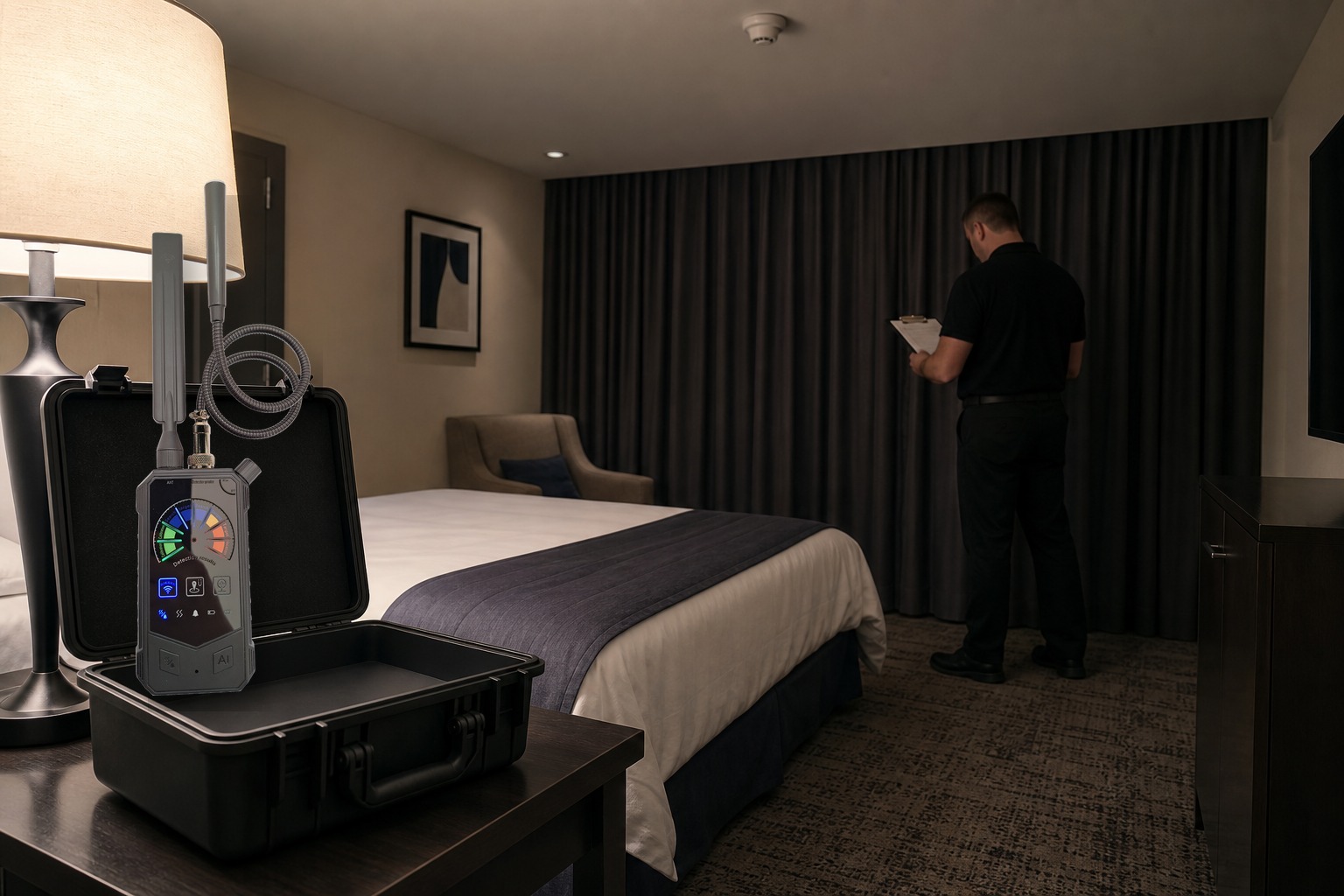
The EL-DE012 uses a different screening path: it checks for 940 nm infrared emissions associated with night-vision cameras. Many covert night-vision cameras use 940 nm infrared LEDs that are generally not visible to the human eye. In an authorized hotel-room or office inspection, fully closing curtains and reducing ambient light can help a camera configured for night vision activate its infrared illumination. When that happens, checking for the 940 nm emission can offer a more practical screening distance than looking for a small lens reflection at close range. The manual lists 0-300 cm for this infrared function.
This distinction matters in distributor training and marketing. Describe the function as a 940 nm night-vision camera check for authorized privacy inspections, not as a guarantee that every hidden camera or every lens will be found. Bright sunlight and artificial light can interfere with infrared checks, so sample evaluation should include a controlled, darkened test condition with closed curtains.
3. Magnetic-source screening: specify the evidence threshold
For fleet-security and authorized vehicle-inspection programs, buyers may request a "magnetic GPS detector." The more accurate requirement is a detector that alerts to a nearby magnetic source. The EL-DE012 manual states a magnetic-source detection distance of up to 20 cm. That is useful for a defined screening workflow, especially when a buyer wants to check accessible areas of company vehicles or assets with permission.
Procurement teams should train users not to turn an alert into a conclusion. The next step is an authorized visual inspection and internal escalation process; a magnetic response by itself is not evidence that a GPS tracker is present. This language is both more accurate and more useful for security distributors who need to support end customers responsibly.
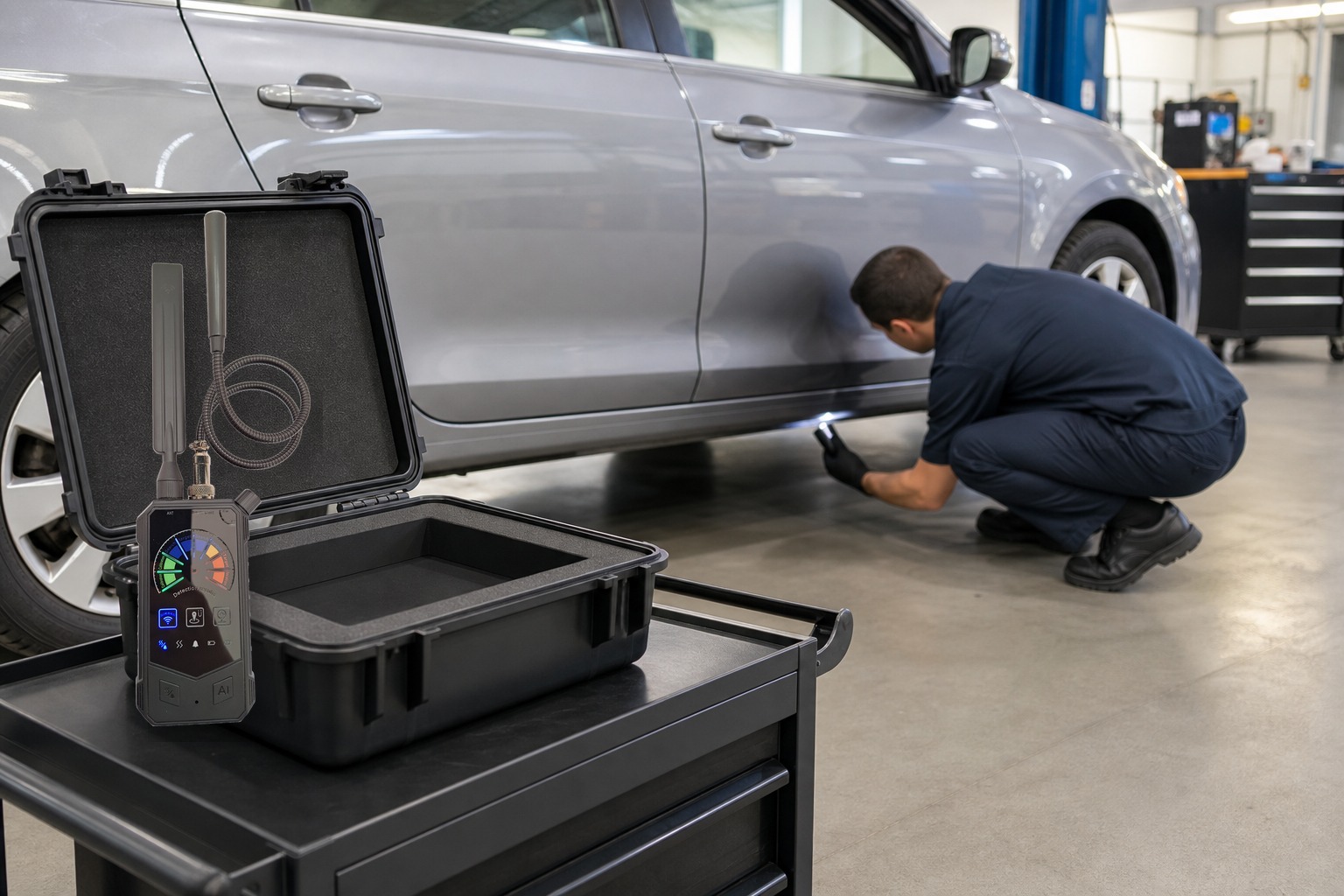
A sample-evaluation checklist for distributors and private-label buyers
- Define the authorized scenario: hotel room, executive office, meeting room, vehicle or another controlled environment.
- Separate the three functions: test RF, 940 nm infrared and magnetic-source modes independently; do not accept a single demonstration as proof of all three.
- Test interference handling: repeat RF checks near normal WiFi and cellular conditions and document the sensitivity setting used.
- Test IR in a controlled room: close curtains, reduce ambient light and use a known night-vision reference only with authorization.
- Test magnetic mode responsibly: validate the response using an approved magnetic reference and an agreed distance, then document the follow-up process.
- Review commercial readiness: request product images, packaging options, manual localization and the OEM/ODM cooperation process before an initial order.
What to ask a supplier before scaling the program
For a first order, ask for a sample plan that covers the three modes, included accessories, charging method, display language, manual options and target-market packaging. A technical comparison is only useful if the distributor can train its team, describe the functions accurately and make a compliant claim to its own customers.
Eleshine has supported B2B security-electronics buyers since 2009 with product selection and OEM/ODM cooperation. Buyers evaluating a new source can also review how to safely source security products from a new China supplier before moving from samples to a repeatable program. To discuss a project, sample requirement or private-label brief, contact Eleshine with your target market, intended application and expected order quantity.
FAQ
Is an RF detector the same as a hidden camera detector?
No. RF detection checks for active wireless-signal environments. A multi-function detector may also include other screening methods, but an RF alert does not identify a device with certainty.
Can the EL-DE012 find every hidden camera lens?
No. Traditional lens-reflection checks require close access to the lens. The EL-DE012 940 nm function checks infrared emissions associated with night-vision cameras under suitable conditions; it is not a guarantee that every camera or lens will be found.
Why close curtains during a 940 nm infrared check?
Lower ambient light can help a night-vision camera activate its infrared illumination. That makes an authorized 940 nm emission check more meaningful. Bright sunlight and artificial light can interfere with the process.
Does a magnetic alert prove that a GPS tracker is installed?
No. It indicates a nearby magnetic source. An authorized visual follow-up and internal review are required before drawing conclusions.
What should a distributor test during sample evaluation?
Test RF sensitivity in realistic interference conditions, 940 nm infrared performance in a controlled darkened room, magnetic response with an approved reference, included accessories, charging, manual language and packaging options.
How Distributors Can Bundle Battery Boxes with Compatible Security Devices
Battery WiFi Camera vs Wired WiFi Camera: A B2B Deployment Guide