A Letter to Our Valued Customers: How to Safely Source from a New Supplier in China
Before You Read
Dear friend,
If you're reading this, chances are we're temporarily out of stock on something you need — or you're looking for a backup supplier for one of our security products.
We completely understand. Business doesn't wait, and neither do your orders.
But before you reach out to a new supplier, we'd like to take a few minutes of your time. As your long-term partner, we want to share with you the real stories and hard lessons we've witnessed over the years. Not to keep you from going elsewhere — but to make sure that wherever you go, you stay safe.
Because we've seen too many customers pay a far greater price than they expected, during the times we couldn't fulfill their orders.
A True Story: When a Smoke Detector Camera Became Just a Smoke Detector
Last year, one of our products — the Smoke Detector Camera — went out of stock for about two months due to a chip shortage.
During that time, one of our long-term customers urgently needed to restock. He reached out to several new suppliers on Alibaba and Google. They replied quickly, their prices looked reasonable, and the PI (Proforma Invoice) was sent over without delay. He paid, waited three weeks, and the shipment arrived.
The moment he opened the box, he froze.
Inside were dozens of ordinary smoke detectors — the kind that cost less than $2 each.
But he had paid the price of a Smoke Detector Camera — over $40 each.
He went back to check the PI. There it was, in black and white: "Smoke Detector" — not "Smoke Detector Camera". One missing word. Several thousand dollars gone.
The supplier? Phone disconnected. WeChat ignored. Company address — fake. Payment account — a personal one.
This isn't an isolated case. It's something that happens in our industry every single month.
Why Are Our Products Especially Vulnerable to This Kind of Scam?
Covert camera products (Smoke Detector Cameras, Clock Cameras, USB Charger Cameras, and so on) share a few characteristics that make them especially easy for scammers to exploit:
🎯 They look almost identical to ordinary household items — you can't tell from a photo 🎯 The price gap is enormous — a regular smoke detector costs $2; the hidden camera version sells for $40–80 🎯 Overseas buyers can't easily inspect goods in person — you rely entirely on the supplier's description and photos 🎯 Product names are easy to manipulate — drop one word, and you're paying for something completely different
Scammers exploit exactly this information gap — playing word games on the PI and leaving you with worthless inventory.
If You Must Find a New Supplier, Please Do These 6 Things
We don't want you to fall into the same trap. If for any reason you need to source from a new supplier, please treat the following checklist as your "seatbelt before driving."
✅ Step 1: Collect and Archive the Supplier's Full Credentials
Before placing any order, request the following documents from your potential supplier — and save copies of everything:
- Chinese Business License (color scan with the red company seal)
- The supplier's actual office address (not just the registered address)
- Legal representative's full Chinese name + mobile number
- Corporate (business) bank account information
Why does this step matter so much?
Not because we expect you to personally verify every detail (we understand that overseas buyers don't always have easy access to Chinese business registry platforms). It matters because:
📁 If a dispute arises, these documents are your core evidence for legal claims, police reports, and recovery efforts 📁 Simply asking for full credentials is itself a screening tool — legitimate suppliers will provide everything readily; scammers will stall, make excuses, or send only blurry copies 📁 If you'd like, you can also send these documents to us, and we'll help you do a basic verification (more on this at the end)
The rule is simple: If a supplier won't even provide a complete business license — or if the company name doesn't match the bank account holder's name — they are not worth the risk.

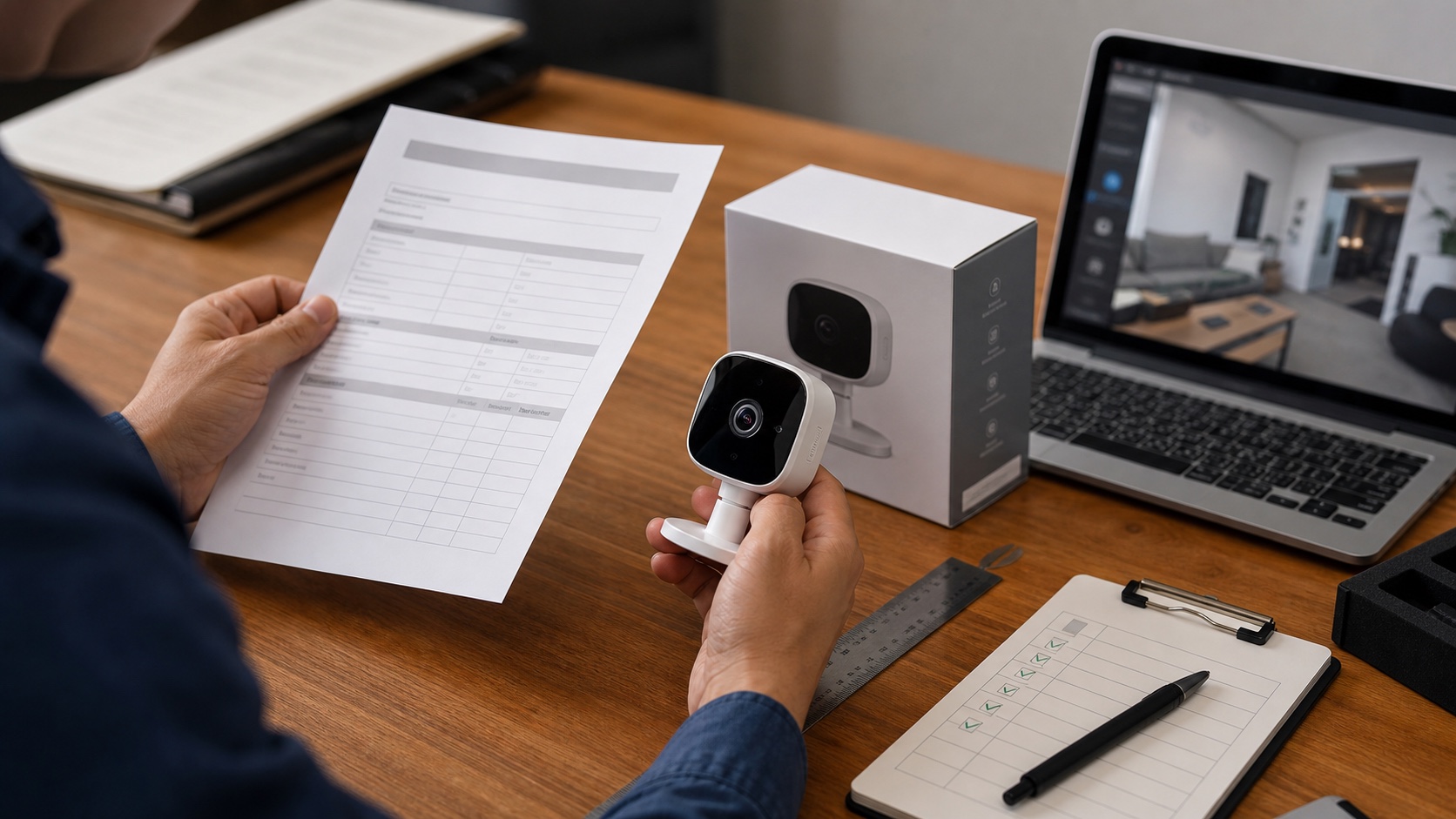
✅ Step 2: Check Every Word on the PI
This is the single most important step for our category of products.
Make sure the PI clearly states:
✅ Smoke Detector Camera — NOT just "Smoke Detector" ✅ Hidden Camera Clock — NOT just "Clock" ✅ WiFi Spy Camera USB Charger — NOT just "USB Charger"
The presence or absence of the word "Camera" can mean a 20x price difference.
Also confirm the PI includes:
- Detailed model number, specifications, and resolution (e.g., 1080P / 4K)
- Clear feature descriptions (WiFi connectivity / motion detection / night vision, etc.)
- The supplier's red company seal (chop)
- Mathematical consistency between unit price, quantity, and total
✅ Step 3: Demand a Real-Time Video — Not Just Photos
Photos can be pulled from anywhere on the internet. Videos are much harder to fake.
Ask your supplier to:
📹 Record a hand-held video of the product, showing it from all angles 📹 Demonstrate the camera's functions on video — WiFi pairing, live view, playback 📹 State the current date AND your company name out loud on the video (so they can't reuse an old clip)
If they refuse, delay, or make excuses like "our factory doesn't allow filming" — walk away.
A seller who's afraid to show you the product on video — is that really someone you trust to ship you real goods?
✅ Step 4: Sample First, Order Later
We know you're in a hurry — but trust us on this: one extra week for sampling can save you tens of thousands of dollars.
Sample order best practices:
- Quantity: 1–3 units is enough
- Test for: actual functionality + image quality + APP connectivity + battery life
- Acceptance criteria: must match the supplier's promises exactly before placing a bulk order
If any single test fails, that supplier is not reliable. Period.
✅ Step 5: Payment Terms Are Your Last Line of Defense
Three rules, non-negotiable:
🔒 Only transfer funds to a corporate (business) bank account — personal accounts = high risk 🔒 For first-time cooperation, never pay more than 30% deposit upfront — settle the balance after inspection 🔒 For large orders, use trade protection services — Alibaba Trade Assurance or third-party escrow
If a supplier insists on 100% prepayment, or demands money be sent to a personal account — that's not business. That's gambling.
✅ Step 6: Arrange Third-Party Inspection
For larger orders (we recommend anything above $3,000), strongly consider hiring a third-party inspection service.
Recommended agencies:
- SGS (Société Générale de Surveillance)
- BV (Bureau Veritas)
- TÜV Rheinland
- Or local independent inspectors in China (more affordable, typically $100–200 per visit)
A few hundred dollars for inspection is excellent insurance against losing tens of thousands.
Red Flag Checklist: Stop Immediately If You See Any of These
To help you make quick decisions, here's a "red alert" summary:
| Warning Sign | Risk Level |
|---|---|
| Requests payment to a personal account | 🔴 Critical |
| Refuses to provide a business license | 🔴 Critical |
| Product name on PI is vague or doesn't match verbal discussion | 🔴 Critical |
| Price is suspiciously low (more than 30% below market) | 🔴 Critical |
| Refuses to record a product video | 🟠 High |
| Cannot be reached by phone, only via WeChat/WhatsApp | 🟠 High |
| Company has been registered for less than 1 year | 🟡 Medium |
| Frequently pressures you to pay quickly | 🟠 High |
If even one critical red flag appears — walk away. Don't gamble on "maybe it'll be fine."
One Last Thing We Want to Say
We wrote this guide with no hidden agenda.
We know there will be times when we're out of stock, and you'll inevitably consider other suppliers. That's normal business logic, and we respect it.
But what we truly hope is this: wherever you go, please don't get scammed.
Because every time a customer is cheated, the loss isn't just money. It's the trust you had in Chinese suppliers. It's the trust your own customers had in you. Sometimes, it's even your passion for this business.
And those are losses we never want to see.
If you have any questions while evaluating a new supplier — even if you ultimately decide not to work with us — please reach out. We're happy to:
✉️ Offer a free reference opinion on a new supplier's credentials ✉️ Help you review a PI for obvious risk points ✉️ Share our read on current market conditions
⚠️ Important Disclaimer: Any verification opinions or recommendations we provide are for reference only. Final purchasing decisions and risk-bearing remain entirely yours. We do not take legal responsibility for the authenticity of any third-party supplier, the quality of their products, or the outcome of your transaction. What we do promise is this: based on our years of industry experience, we will give you our most honest assessment.
📩 Contact Us:
👤 Owen 📧 owen@eleshine.tech
Thank you for the trust you've placed in us over the years. No matter how the market changes, we hope to remain the partner you can always count on.
FAQ: Safe Supplier Sourcing for B2B Security Buyers
Below are the questions we hear most often from customers navigating new supplier relationships. We hope these direct, no-nonsense answers help you avoid the most common pitfalls.
A real Chinese business license has a few unmistakable features: a red company seal (chop), an 18-digit Unified Social Credit Code, the legal representative's name in Chinese, and the registered capital. If anything looks blurry, hand-edited, or missing — that's a warning sign. If you'd like a second opinion, send it to us and we'll take a look (for reference only).
No. This is one of the biggest red flags in China sourcing. A legitimate Chinese company's business bank account must legally match the registered company name — exactly. If the names don't match (even by one character or one word), stop the transaction immediately. This is the #1 sign of a shell company or scam operation.
Never. No legitimate exporter in China handles B2B international transactions through personal Alipay or WeChat. These platforms are designed for personal use, and any payment sent this way is virtually impossible to recover if something goes wrong. A real supplier will always have a corporate USD bank account for international wire transfers.
If a price is 30% or more below market average, treat it as a danger signal — not a bargain. In our industry, hidden camera products have stable component costs. A price that "seems too good to be true" almost always means one of three things: (1) it's a different product than what you think, (2) the quality is far below standard, or (3) it's an outright scam.
Act fast. Within the first 48 hours:
Gather all evidence — PI, chat records, payment receipts, the supplier's business license
File a report with the local Chinese police (Public Security Bureau) where the supplier is registered — you can do this remotely through a Chinese lawyer
Report to your country's trade authority and the platform where you found the supplier (Alibaba, Made-in-China, etc.)
Yes — but only if you use it correctly. Trade Assurance only protects you if: (1) you pay through Alibaba's official payment channel (not directly to the supplier's bank), (2) the contract terms are clearly defined on the platform, and (3) you file disputes within the protection window. Many buyers think they're "covered" simply because the supplier is a Gold Supplier — that's not how it works. Always pay through the platform.
Yes. We'll give you our honest read on the supplier's credentials, PI, and pricing — for reference only. We won't pretend we can guarantee anything about a third party we've never worked with, but we'll tell you what we'd do in your position. Send the documents to owen@eleshine.tech and we'll get back to you within 1–2 business days.
How to Choose a Long-Standby Battery WiFi Camera for B2B Security Projects